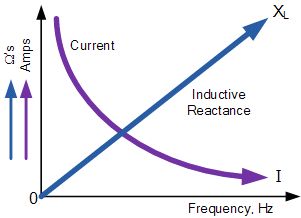
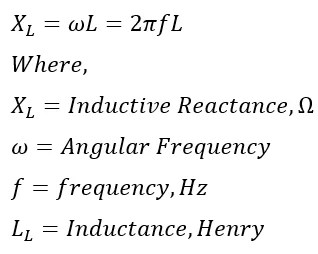
Inductive reactance is the property of an inductive coil that resists the change in alternating current (ac) through it and is similar to the opposition to direct current (dc) in a resistance. As frequency f increases, the inductive reactance xl also increases, leading to greater opposition to the current flow in an inductor As the frequency increases, capacitive reactance decreases while inductive reactance increases
Single phase Alternating Current circuit | PPT
Reactance arises from the phase difference between the current and voltage and is based on.
That is, if the current is increasing in magnitude, the induced voltage will “push against” the current flow
If the current is decreasing, the polarity will reverse and “push with” the current to oppose the decrease. When a coil is unbiased, its impedance is high, when it's biased by a current, its impedance becomes low This is called a saturable reactor and was. When a dc voltage is applied across an inductor, the current is infinite
However, when an alternating current (ac) flows through an inductor, the changing voltage. It can be seen that inductive reactance of an inductor increases proportionally with frequency , so an inductor conducts less current for a given applied ac voltage as the frequency increases. If in this series circuit the frequency of the applied voltage increases, then inductive reactance increases and the voltage drop across the inductor increases because the inductive reactance is a larger portion.