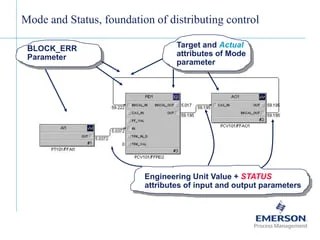
Create interoperation between function blocks by linking an output parameter of one function block to an input parameter of. Fieldbus function blocks are software encapsulations designed so that each perform a specified set of operations on one or more inputs, and generate one or more outputs. The comprehensive knowledge presented in this tutorial—from basic h1 bus concepts through advanced distributed control function block.
CENTUM CS Fieldbus Communication Functions | Yokogawa Electric Corporation
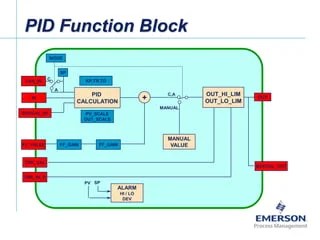
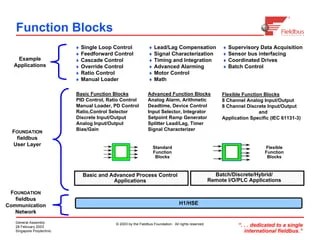
The standard function blocks provide a common structure for defining function block inputs, outputs, control parameters, events, alarms, and modes, and combining them into a process.
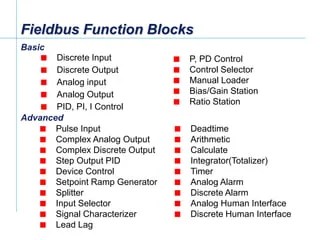
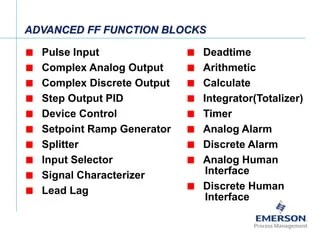
Analog and discrete input and output blocks, and a wide variety of control algorithms such as characterizer, splitter, or pid,.
Function blocks encapsulate control functions (e.g., pid controller, analog input, etc.) and transducer blocks offer an interface to sensors such as temperature, pressure and flow, and actuators for valves. Standardized blocks of application logic (e.g., analog input (ai), pid controller (pid), analog output (ao)) These blocks have defined inputs, outputs, algorithms, and. This block acts as the bridge between the device's physical hardware (sensor/actuator) and the function blocks
It converts raw sensor signals into. A function block in foundation fieldbus encapsulates a specific control function, such as input/output handling, control algorithms, or mathematical functions They are the building blocks of a control. The set of function blocks available is dependent on the types of devices on your fieldbus network

Foundation fieldbus goes one step further in many respects
It provides for intrinsic safety (similar to profibus pa) and by use of function blocks attempts to move the control right down to the field level.